Nuffnang

Showing posts with label Faces. Show all posts

Friday, July 23, 2010

Interpreting and Misinterpreting by Allan Pease

The ability to accurately interpret hand-to-face gestures in a given set of circumstances takes considerable time and observation to acquire. We can confidently assume that, when a person uses one of the hand-to-face gestures just mentioned, a negative thought has entered his mind. The question is, what is the negative? It could be doubt, deceit, uncertainty, exaggeration, apprehension or outright lying. The real skill of interpretation is the ability to pick which of the negatives mentioned is the correct one. This can best be done by an analysis of the gestures preceding the hand-to-face gesture and interpreting it in context.

For example, a friend of mine with whom I play chess often rubs his ear or touches his nose during the game, but only when he is unsure of his next move. Recently I noticed some of his other gestures that I can interpret and use to my advantage. I have discovered that when I signal my intention to move a chess piece by touching it, he immediately uses gesture clusters that signal what he thinks about my proposed move. If he sits back in the chair and uses a steepling gesture (confidence), I can assume that he has anticipated my move and may already have thought of a counter move. If, as I touch my chess piece, he covers his mouth or rubs his nose or ear, it means that he is uncertain about my move, his next move or both. This means that the more moves I can make after he has reacted with a negative hand-to-face gesture, the greater my chances of winning.

I recently interviewed a young man who had arrived from overseas for a position in our company. Throughout the interview he kept his arms and legs crossed, used critical evaluation clusters, had very little palm exposure and his gaze met mine less than one-third of the time. Something was obviously worrying him, but at that point in the interview I did not have sufficient information for an accurate assessment of his negative gestures. I asked him some questions about his previous employers in his native country. His answers were accompanied by a series of eye-rubbing and nose-touching gestures and he continued to avoid my gaze. This continued throughout the rest of the interview and eventually I decided not to hire him, based on what is commonly called ‘gut feeling’. Being curious about his deceit gestures, I decided to check his overseas referees and discovered that he had given me false information about his past. He probably assumed that a potential employer in another country would not bother to check overseas references and, had I not been aware of non-verbal cues and signals, I might well have made the mistake of hiring him.

During a role play of an interview scene at a management seminar, the interviewee suddenly covered his mouth and rubbed his nose after he had been asked a question by the interviewer. Up to that point in the role-play, the interviewee had kept an open posture with open coat, palms visible and leaning forward when answering questions, so at first we thought it might have been an isolated series of gestures. He displayed the mouth guard gesture for several seconds before giving his answer, then returned to his open pose. We questioned him about the hand-to-mouth gesture at the end of the role play and he said that, when he had been asked the particular question, he could have responded in two ways; one negative, one positive. As he thought about the negative answer and of how the interviewer might react to it, the mouth guard gesture occurred. When he thought of the positive answer, however, his hand dropped away from his mouth and he resumed his open posture. His uncertainty about the audience’s possible reaction to the negative reply had caused the sudden mouth guard gesture to occur.

These examples illustrate how easy it can be to misinterpret a hand-to-face gesture and to jump to wrong conclusions. It is only by constant study and observation of these gestures and by having regard to the context in which they occur that one can eventually learn to reach an accurate assessment of someone’s thoughts.


Other books by Allan Pease

Why Men Want Sex and Women Need Love: Solving the Mystery of Attraction   Why Men Don't Have a Clue and Women Always Need More Shoes: The Ultimate Guide to the Opposite Sex   Why Men Don't Listen and Women Can't Read Maps: How We're Different and What to Do About It   Why Men Lie and Women Cry

Saturday, June 26, 2010

Element of Body language: Face

We have pretty much known about facial expressions are universal, from the post 'Facial Expressions Are Universal'. Therefore, face is one of key elements of body language commonly shared by you, me and everyone else. The following article is written by Kevin Hogan explaining some of the features and applications displayed by your face.

***

Many experts consider facial expressions the most important non-verbal behaviour of all. Your face is the focal point of conversation and interaction, so the impact of its movements and expressions is magnified. The face is a tool for communicating emotions and feelings, but it is important for regulating and regulating and directing an interaction.

Let's say you are interacting with another person is already talking, your facial expression will change to indicate you want a turn. Your eyebrows rise slightly and your mouth opens as if you are about to speak. Smiling is a facial expression used when listening to someone else as a way of encouraging them, acknowledging what they are saying, and signalling you are interested in what they are saying.

Facial expressions can communicate nearly any emotion you want, the most common being happiness, fear, disgust, anger, sadness and surprise. They are typically appear as follows:

  • Happiness – Lips pull back and up at the corners; cheeks raise up; so called crow's feet wrinkles become noticeable on the outside of the eyes.

  • Fear – Mouth opens slightly; lips are tense; eyebrows rise up and together; forehead wrinkles in the centre; upper eyelid rises up.

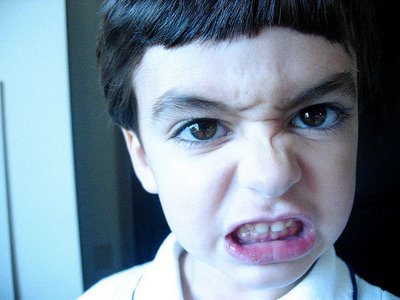
  • Disgust – Nose wrinkles up; cheeks raise up; eyebrows lower; upper lip rises up; lower lip may be raised up against the upper lip or lowered slightly and pushed out.

  • Anger – Eyes stare with contracted pupils, perhaps seeming to bulge out; eyebrows lower, coming together and creating wrinkles between them; lips may be tense and pressed together or tense and open.

  • Sadness – Lips draw down in the corners, perhaps trembling; eyebrows rise up slightly; upper eyelid rises up in the inner corner.

  • Surprise – Eyelids open wide; eyebrows arch up; wrinkles appear across entire forehead; jaw drops and mouth opens.

Your face is a useful flirtion device. (It's like a floatation device on an airplane... okay, maybe not.)

A smile, a wink, and raised eyebrows in the right social situation can attract another person's attention and communicate interest. Once a conversation is started, these same facial expressions help to encourage further interest and interaction. The power of facial expressions for attracting and engaging someone else is so big that it can become a misused tool for manipulating or otherwise influencing another person.

There are cultural differences in how facial body language is interpreted as well. For instance, Americans tend to read more emotion into the face than do Japanese. Americans put their focus on the mouth when trying to understand what someone is saying. The Japanese put their attention on the eyes.

People from the same culture are more accurate in reading each other's 'facial expressions, a finding you would expect, of course.

Facial expression can be either deliberate or spontaneous depending on the person and the situation. Children tend to show their facial expressions spontaneously, with little or no deliberate control. Adults, on the other hand, have learned through the years to mask or control certain facial expressions in certain situations where they are considered inappropriate or unwise.

Can you identify the facial expressions in the picture below? 


Answers

Top Left: Anger
Top Right: Fear
Middle Left: Digust
Middle Right: Surprise
Bottom Left: Happiness
Bottom Right: Sadness


Other books by Kevin Hogan

The Secret Language of Business: How to Read Anyone in 3 Seconds or Less    The 168 Hour Week: Living Life Your Way 24-7   The Psychology of Persuasion: How To Persuade Others To Your Way Of Thinking

Saturday, May 29, 2010

Emotions Revealed - KQED QUEST


Is your face giving you away? Meet renowned psychologist Paul Ekman, who has spent his life studying how our facial muscles involuntarily reveal emotions like sadness and anger. His comprehensive catalog of human facial expressions has become an important tool for everyone from law enforcement agents to animators.

 
 Emotions Revealed, Second Edition: Recognizing Faces and Feelings to Improve Communication and Emotional Life