Nuffnang

Showing posts with label Anger. Show all posts

Saturday, June 26, 2010

Element of Body language: Face

We have pretty much known about facial expressions are universal, from the post 'Facial Expressions Are Universal'. Therefore, face is one of key elements of body language commonly shared by you, me and everyone else. The following article is written by Kevin Hogan explaining some of the features and applications displayed by your face.

***

Many experts consider facial expressions the most important non-verbal behaviour of all. Your face is the focal point of conversation and interaction, so the impact of its movements and expressions is magnified. The face is a tool for communicating emotions and feelings, but it is important for regulating and regulating and directing an interaction.

Let's say you are interacting with another person is already talking, your facial expression will change to indicate you want a turn. Your eyebrows rise slightly and your mouth opens as if you are about to speak. Smiling is a facial expression used when listening to someone else as a way of encouraging them, acknowledging what they are saying, and signalling you are interested in what they are saying.

Facial expressions can communicate nearly any emotion you want, the most common being happiness, fear, disgust, anger, sadness and surprise. They are typically appear as follows:

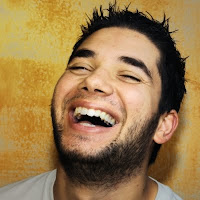
  • Happiness – Lips pull back and up at the corners; cheeks raise up; so called crow's feet wrinkles become noticeable on the outside of the eyes.

  • Fear – Mouth opens slightly; lips are tense; eyebrows rise up and together; forehead wrinkles in the centre; upper eyelid rises up.

  • Disgust – Nose wrinkles up; cheeks raise up; eyebrows lower; upper lip rises up; lower lip may be raised up against the upper lip or lowered slightly and pushed out.

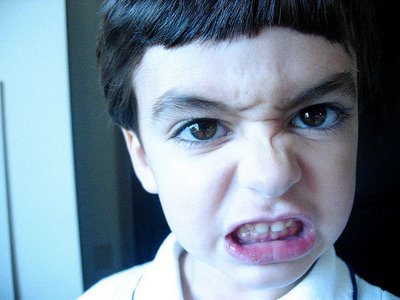
  • Anger – Eyes stare with contracted pupils, perhaps seeming to bulge out; eyebrows lower, coming together and creating wrinkles between them; lips may be tense and pressed together or tense and open.

  • Sadness – Lips draw down in the corners, perhaps trembling; eyebrows rise up slightly; upper eyelid rises up in the inner corner.

  • Surprise – Eyelids open wide; eyebrows arch up; wrinkles appear across entire forehead; jaw drops and mouth opens.

Your face is a useful flirtion device. (It's like a floatation device on an airplane... okay, maybe not.)

A smile, a wink, and raised eyebrows in the right social situation can attract another person's attention and communicate interest. Once a conversation is started, these same facial expressions help to encourage further interest and interaction. The power of facial expressions for attracting and engaging someone else is so big that it can become a misused tool for manipulating or otherwise influencing another person.

There are cultural differences in how facial body language is interpreted as well. For instance, Americans tend to read more emotion into the face than do Japanese. Americans put their focus on the mouth when trying to understand what someone is saying. The Japanese put their attention on the eyes.

People from the same culture are more accurate in reading each other's 'facial expressions, a finding you would expect, of course.

Facial expression can be either deliberate or spontaneous depending on the person and the situation. Children tend to show their facial expressions spontaneously, with little or no deliberate control. Adults, on the other hand, have learned through the years to mask or control certain facial expressions in certain situations where they are considered inappropriate or unwise.

Can you identify the facial expressions in the picture below? 


Answers

Top Left: Anger
Top Right: Fear
Middle Left: Digust
Middle Right: Surprise
Bottom Left: Happiness
Bottom Right: Sadness


Other books by Kevin Hogan

The Secret Language of Business: How to Read Anyone in 3 Seconds or Less    The 168 Hour Week: Living Life Your Way 24-7   The Psychology of Persuasion: How To Persuade Others To Your Way Of Thinking

Sunday, June 20, 2010

Facial Expressions Are Universal

Humans have evolved certain facial expressions that are so universal that all but the least perspective individuals can recognise them.' This is quoted from a book 'The Body Language Handbook: How To Read Everyone's Hidden Thoughts And Intentions' written by Gregory Hartley and Maryann Karinch. In the book, it mentioned that each universal expression has degrees and the differences characteristics combine with slightly different mental states to cause variations.

This is why certain expressions fall into the category of “universal” is based on research with diverse populations. The most well-known researches were conducted by Paul Ekman of the Human Interaction Laboratory at University of California's School of Medicine supported the observation that certain facial expressions are universal. The common expressions included in his work “Facial Expressions and Emotion: An Controversy and New Findings” are disgust, sadness, fear, anger, surprise and enjoyment (or happiness). Later, he added in contempt, pride, uncertainty and embarrassment. People try to mask them, but they still come out. As humans, we have a natural ability to interpret that base body language. Whether the constrained body language is a personal choice or cultural is a tough call by looking at one person. Biology and bone structure often play as big part as culture.

Bodies adapt to what we do. A long-distance runner who decides to take up weight training and become a competitive bodybuilder has to make adjustments in the way muscles are used – to recondition them the way you would tune a piano. When the wires become accustomed to holding one shape, the piano tuner has a big job: He has to come back repeatedly to condition the wires to stay in tune. The same thing happens with your face. Muscle memory kicks in and dictates how you use it, and shows all the world how you have used it in the past.

Of all the facial expression listed – disgust, sadness, fear, anger, surprise, happiness, contempt and pride – can you recall any of them?

Try look at these photos. What do you see in common?


All three of the photos have a clear, external focus, raised chin and set mouth that suggests pride. A look of pride can be associated with both positive and negative situations, but the emotion is the same. When a police officer confronts a gang member in front of his buddies, the gang member will stand indignantly, raise his head, and flash pride. It maybe just be the pride of “I got your attention.” But in the photo on the right, the kid is showing pride after doing something his parents are proud of. Both are pride rooted in accomplishment and acknowledgement.

Even someone who knows you well and feels comfortable with you will occasionally show some of the same signs of uncertainty that a stranger, or someone unfamiliar with your culture, will show. You can surprise him or her with a request or ask for her opinion on a topic that causes anxiety.

For example, you were asked to participate in a lucky draw contest by an unknown event representative while walking in the shopping mall. Obviously, you would have no idea of what the contest was all about. You would most likely to give a look of uncertainty. While she explained the process to you, you could probably be interpreting what she said and trying to organise the information so that you could be ready to participate.

With some emotions, you don't even need the whole face. The eyes say it all. It's all part of why for generations we have been quoting the proverb “the eyes are the windows to the soul.”

The Body Language Handbook: How to Read Everyone's Hidden Thoughts and Intentions


Other titles related to Facial Expressions

Unmasking the Face: A Guide to Recognizing Emotions From Facial Expressions  Emotions Revealed, Second Edition: Recognizing Faces and Feelings to Improve Communication and Emotional Life  The Psychology of Facial Expression (Studies in Emotion and Social Interaction)